What Does the “Gay Agenda” Actually Want? The Answer Might Surprise You
What if the phrase you’ve heard your entire life—used as a warning, a political weapon, a source of fear—was never really about what you were told? What if the so-called “gay agenda” isn’t a coordinated plot but something far more human, far more quiet, and far more urgent than any headline has ever acknowledged?
The Weight of Growing Up Without a Map
Imagine being twelve years old and knowing something about yourself that you have no words for. You haven’t read about it. No one around you has named it. The adults in your life are arguing loudly—something that sounds like it might be about you—but no one is speaking to you. You sit in classrooms where your existence is treated as a controversy. You absorb the silence of teachers who have been told that neutrality is safer than acknowledgment. You learn, without anyone saying it directly, that what you are is something to hide.
This is not a hypothetical. For millions of young LGBTQ people, this is the ordinary texture of adolescence. The psychological toll of years spent hiding, concealing, and performing a false identity doesn’t announce itself dramatically—it accumulates. Minority stress, as researchers call it, builds invisibly over time. It doesn’t disappear when someone appears to be functioning well. In fact, high-achieving young people are often under the greatest pressure to maintain the appearance of normalcy, so the cost of hiding is often highest among those who, from the outside, look like they’re doing fine. Meanwhile, the adults in their lives are arguing about whether they should be allowed to exist visibly at all—and the young person is quietly listening to every word.
When Evidence Replaces Fear
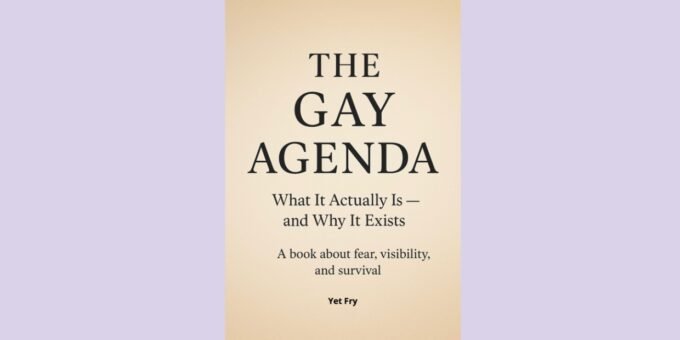
This is precisely why The Gay Agenda: What It Actually Is — and Why It Exists arrives at exactly the right moment. Rather than adding to the noise of political debate, it does something rarer and more valuable: it follows outcomes. It asks not what people believe about gay identity, but what the research shows about what happens to people depending on how they are treated. What you’re about to discover will fundamentally change how you understand the phrase “gay agenda”—and, more importantly, how you understand the young people it has always been used to describe.
A Book Built on Evidence, Not Ideology
The Gay Agenda draws on established research in psychology, public health, education, and sociology to trace a clear yet often overlooked arc: what happens when a person realizes they are gay, and what determines whether that realization leads to survival or crisis. The book is written in clear, accessible language—free of academic jargon and political rhetoric—and it does not ask readers to abandon their beliefs or adopt a particular ideology. It asks a more fundamental question: What reduces harm, and what makes it worse?
One of the book’s most important contributions is its evidence-based reframing of a statistic that is often cited yet rarely examined closely. Higher rates of suicidal ideation among gay youth are not caused by being gay. When researchers control for rejection, bullying, and lack of support, the disparity narrows dramatically. The environment—not the identity—determines outcomes. This distinction matters enormously because it means the crisis is preventable. It also means that silence, neutrality, and the erasure of visibility in schools are not neutral positions. They are choices with measurable consequences.
The book also explores what acceptance actually does—and what it does not do. Acceptance does not create gay people. It does not recruit, convert, or indoctrinate. What it does is reduce shame-driven harm. In public health terms, it functions as an intervention. A young person who receives even a single message that says they are not alone and not broken is statistically more likely to survive adolescence intact. That is not ideology. That is harm reduction. And it is the foundation on which everything the book calls the “gay agenda” rests.
What the Research Reveals—and What It Changes
Perhaps the most quietly devastating insight in The Gay Agenda is its treatment of moral panic—the way fear travels faster than facts and how corrections rarely reach as far as accusations in media ecosystems that reward outrage over nuance. Moral panics are not new, and the book traces how they form, why they repeat, and what they cost. The cost is not abstract. Every time a debate about drag story hours, safe spaces in schools, or LGBTQ visibility in classrooms sparks a wave of fear-based coverage, gay youth absorb that ambient hostility. They are learning, again, that their existence is considered dangerous. They are retreating further into self-surveillance, hiding, and silence—and the risk that silence carries is not metaphorical.
The book also addresses one of the most persistent and damaging conflations in these debates: the confusion between discomfort and harm. When policies prioritize the discomfort of a majority over the safety of a minority, they are not achieving balance—they are choosing whose well-being counts. Drag and storytelling programs, for example, are routinely misrepresented as sexual, even though their purpose is to serve as voluntary, age-appropriate community events that offer visibility to children who have never seen themselves reflected anywhere. Visibility is not instruction. It is not pressure. For a young person who has been invisible, it is permission—permission to believe that a future exists for them.
The book’s author brings not only rigorous research but also deep creative and emotional intelligence to this subject. Known for gay fiction, psychological thrillers, and romance shorts that explore love, identity, and suspense with equal precision, Yet Fry understands what it means to inhabit emotional landscapes where survival and identity are inseparable. That sensibility is present throughout The Gay Agenda—a book that, at its core, is about the young person who quietly listens as adults argue about their existence and what it would mean for that person to finally hear something different.
The Agenda Is Painfully Ordinary
As the book puts it in its closing pages: “The agenda, if there is one, is painfully ordinary: to grow up, to be honest, to be safe, to be loved, to stay alive.”
That sentence is worth sitting with. What has been framed for decades as a coordinated threat—a secretive, coercive force reshaping society against its will—is, when examined through evidence rather than fear, something else entirely. It is the collective, documented response to measurable harm. It emerges after realization, fear, hiding, and rejection. It is not a plot. It is a survival strategy. And for the kid who needs it, as the book’s final lines remind us, it is not an ideology. It is a lifeline.
“Fear thrives in silence. Acceptance reduces harm. Visibility saves lives. Panic distorts reality.”
These are not political statements. They are findings, and they are the reason this book exists.
Ready to See the Evidence for Yourself?
If you’ve ever wanted to understand what the research actually says—about gay youth, acceptance, and why visibility, safe spaces, and Pride exist—The Gay Agenda by Yet Fry offers something rare: clarity without agenda, evidence without ideology, and humanity without apology. Whether you are an LGBTQ reader who has lived these realities, an ally seeking to understand them more deeply, or someone who has only ever encountered this subject through political debate, this book will transform how you see the conversation.
Don’t let another young person’s story go unexamined. Get your copy to discover what the evidence has always said: AMAZON
Enjoy LGBTQIA+ books, movies, and queer culture?
See More TWiT LGBT Book Reviews
Facebook | BlueSky | Instagram | Threads | Printrest
#GayAgenda #LGBTQBooks #YouthSurvival #AcceptanceAsMedicine #VisibilityAsLifeline #HarmReduction #LGBTQYouth #ShameAndIdentity #SilenceAsErasure #MoralPanic