


Netflix’s limited series Eric arrives draped in the grime and anxiety of 1980s New York, but beneath its noir exterior lies something far more intimate and devastating: a meditation on fathers and sons, on inheritance beyond blood, and on what it meant to exist as a queer person in a city—and a system—that was openly hostile to your survival.
 At its core, Eric is about a father searching for his missing son. Benedict Cumberbatch plays Vincent, a brilliant, volatile puppeteer whose public success masks a private chaos. His relationship with his young son Edgar is strained, loving, resentful, and deeply human. The series understands that parenting is rarely a clean slate; we pass down our damage as easily as our love. Vincent’s emotional distance, his addiction, and his inability to communicate don’t appear in a vacuum—they echo a lineage of unresolved trauma. Eric asks a painful question: how many generations does it take for harm to become intentional, and how many before it can finally stop?

That generational theme extends beyond Vincent’s household. It reverberates through institutions—most notably the NYPD of the 1980s, depicted here as deeply corrupt, casually brutal, and virulently homophobic. Eric does not soften this reality. The department is shown as a place where being gay is not merely a liability, but a potential death sentence for one’s career—and sometimes one’s life. Officers suspected of being queer are ostracized, targeted, or destroyed.
McKinley Belcher III delivers a quietly shattering performance as Detective Ledroit, a closeted Black gay man navigating a workplace that would erase him entirely if given the chance. His performance captures the exhausting calculus of survival: how to walk, how to speak, how much truth is too much. Ledroit’s vigilance is not paranoia—it’s strategy. Watching him contort himself to remain invisible is one of the series’ most painful throughlines, and a stark reminder of how many queer people were forced to live double lives simply to keep their jobs, their safety, their breath.
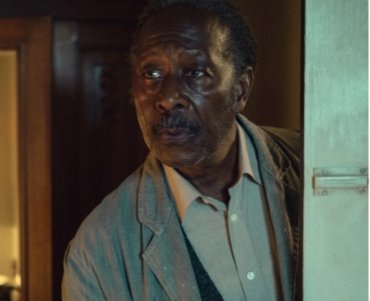
Clarke Peters’ tender portrayal of George is especially devastating in this context. His performance embodies a generation of gay men who loved fiercely and paid dearly for it. George’s quiet dignity in the face of systemic indifference becomes a form of resistance, and Peters brings an aching humanity to a role that could easily have been reduced to symbolism.
Threaded through all of this darkness is the strange, unsettling beauty of Vincent’s puppet show—the origin of “Eric” himself. The puppets are not escapism; they are confession. Created by Vincent and performed for children, the show becomes a surreal mirror of his internal world, a place where emotions he cannot articulate are allowed to exist. Eric, the monstrous blue puppet imagined by Edgar, represents fear, rage, protection, and longing all at once. In a series obsessed with what is hidden, the puppets are paradoxically the most honest characters on screen.
 Gabby Hoffmann delivers a phenomenal performance as Cassie, Edgar’s mother, grounding the series with a ferocity that feels earned rather than theatrical. She is a woman forced to carry emotional labor for everyone around her, and Hoffmann plays her with raw intelligence and restraint. Her grief is not loud, but it is relentless.
The supporting cast further elevates the series. Bamar Kane brings warmth and moral clarity to Yuusuf, a character who represents chosen family and quiet integrity. Wade Allain-Marcus’ Gator injects sharp-edged vulnerability, embodying survival in a city that devours its own. Chloe Claudel’s Ellis adds nuance and emotional texture, reinforcing the idea that empathy is often found in unexpected places.
What makes Eric resonate so deeply for an LGBTQIA audience is its refusal to sanitize history. It does not romanticize the 1980s, nor does it treat queer suffering as a plot device. Instead, it insists on memory. It reminds us that progress came at an unbearable cost—and that the echoes of that cost still live in our families, our institutions, and our bodies.
Ultimately, Eric is not just a mystery or a period drama. It is a reckoning. With masculinity. With inheritance. With the systems that taught generations of queer people to hide, to lie, to disappear—and with the resilience that allowed them to survive anyway.
Eric is currently available to stream on Netflix.