When the Person You Trust Most Is the One Sent to Destroy You.
What happens when you lose the person you love most — and the only one who seems to understand your grief is the one responsible for their death?
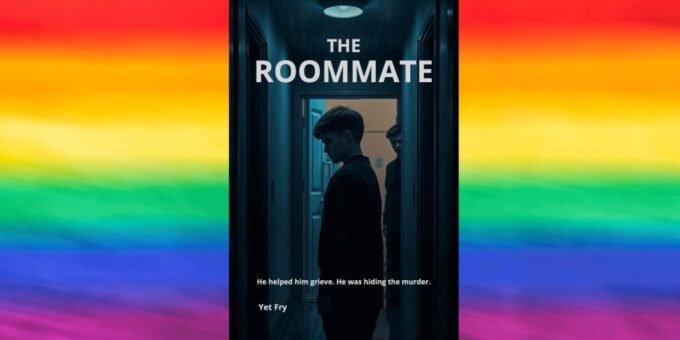
That question sits at the terrifying heart of The Roommate, a dark LGBTQ psychological thriller by Yet Fry that refuses to let its readers breathe. If you’ve ever felt dismissed even when you knew something was wrong, or reached out for support only to wonder whether the hand extended toward you was genuine — this story was written for you.
When Grief Becomes a Weapon
There is a particular kind of loneliness that follows the traumatic loss of a partner. It isn’t just the absence of a person. It’s the loss of a shared language, a shared future, and the version of yourself that only existed within that relationship. For LGBTQ individuals, that grief can be compounded by something even more corrosive: the experience of having it dismissed, minimized, or actively suppressed by the very institutions that should offer protection.
You go to the police. They close the case quickly. You raise your concerns with family — his family — and they want silence, not questions. You look for someone who will simply listen, and the isolation becomes its own kind of violence. This is the reality Robbie Walsh inhabits at the opening of The Roommate. His boyfriend, Mark, is dead, ruled an accidental fall from a bridge in West Lafayette, Indiana. The system has moved on. Everyone around Robbie is moving on. And Robbie — shattered, sleep-deprived, and drowning in grief — is left alone with a certainty no one will validate: something is wrong, and the truth is being buried.
What makes this situation uniquely devastating for LGBTQ readers is how deeply familiar the institutional indifference feels. The fear of not being believed when reporting a suspicious death. The impossibility of seeking justice through systems that may be hostile or simply indifferent to queer lives. The psychological cost of performing normalcy — of getting up, going to class, nodding when people say he’s in a better place — while carrying the unbearable weight of a truth no one wants to hear. Robbie’s grief is real, raw, and rendered with unflinching precision. It leaves him vulnerable in ways a predator can easily exploit.
The Manipulation You Never See Coming
This is exactly why Yet Fry wrote The Roommate — to illuminate the precise mechanics by which grief and isolation can be weaponized against those already most at risk.
Then Billy Morgan appears.
He is calm. He is compassionate. He is a junior psychology major who seems to understand Robbie’s fear, anger, and confusion in a way no one else does. He listens. He validates. He makes Robbie feel, for the first time since Mark’s death, that he is not alone. And that is the trap.
What The Roommate does with devastating intelligence is map the full architecture of psychological manipulation — not as a vague, cinematic concept, but as a documented, step-by-step system. Billy works for the New Dawn Foundation, a secretive network linked to conversion therapy camps and violent cover-ups. His assignment is deceptively simple: keep Robbie under control and ensure the truth about Mark’s death never surfaces. To accomplish this, Billy employs what can only be described as a gaslighting weapon system. He establishes trust through shared vulnerability, mirroring Robbie’s pain with apparent authenticity. He normalizes anomalies — the missing ring, the inconsistencies in the official account — by offering plausible alternative explanations. He co-opts external threats, positioning himself as Robbie’s only ally against a world that doesn’t understand. And when Robbie’s perceptions sharpen into something dangerous, Billy frames his accurate instincts as symptoms of grief-induced psychosis.
The result is a portrait of psychological warfare so precise it will make you question every relationship where someone seemed to appear at exactly the right moment. The Roommate doesn’t just tell you that gaslighting is harmful. It shows you, scene by scene, how a sophisticated manipulator dismantles a person’s grip on reality — and how the very love and need for connection that make us human can become the perfect trap.
Evidence Is the Only Language Power Understands
What elevates The Roommate beyond a conventional thriller is its unflinching argument that survival for the most vulnerable among us depends not on being believed — but on making the truth impossible to ignore.
Robbie Walsh is not a trained investigator. He has no institutional support, no financial resources, and no allies he can fully trust. What he has is a methodical, desperate intelligence and the understanding — articulated with chilling clarity by investigative reporter Anya Sharma — that physical, contemporaneous evidence is his only real protection. So he builds a dossier. He photographs a contract. He records a phone call. He documents Mark’s ring and recovered ID. He distributes copies across cloud storage, email, and a hidden USB drive, knowing that once evidence exists in multiple places, silencing him becomes too costly even for an organization as powerful as New Dawn.
This is one of the novel’s most quietly radical insights: for LGBTQ individuals facing institutional hostility, the path to justice rarely runs through official channels. It runs through documentation, through witnesses, and through the kind of public exposure that makes cover-ups more dangerous than the truth. Anya Sharma’s role in the story — as a journalist who understands that publication creates a spotlight — reframes chosen family and solidarity in urgent, practical terms. She is not just an ally. She is a strategy.
And then there is the moment that will linger with readers long after the final page: Robbie reading the last messages on Mark’s recovered phone. Mark (10:08 PM): He says his name is William. The world stopped. Robbie’s blood turned to ice. In a single text, the entire architecture of Billy’s deception collapses — and Robbie must confront the most terrifying truth of all. The person he trusted with his grief, the one who listened when no one else would, was at the bridge the night Mark died.
The Insights That Will Change How You Read a Thriller
The Roommate offers something rare in psychological suspense: it doesn’t just create fear. It fosters understanding.
The first insight concerns the nature of gaslighting itself. As Robbie comes to realize, you can’t negotiate with a mirror that reflects only your own madness. Billy’s manipulation is so complete, so architecturally sound, that any attempt by Robbie to confront him directly would only result in further discrediting. This is the trap that so many survivors of psychological abuse recognize with a sick lurch of familiarity — the moment you understand that the system of control has been designed to make your accurate perceptions look like symptoms. The terror of not knowing whether you are uncovering a real conspiracy or experiencing a mental breakdown is one of the novel’s most psychologically precise renderings, and it does so without ever condescending to its protagonist or its reader.
The second insight arrives through Leo, a secondary character whose presence reframes the story’s emotional stakes. “Because nobody was there for David,” he tells Robbie. “And when I talked to Mark, I heard his voice — scared, but so damn brave. He deserved a chance. He didn’t get it. Maybe you can.” In this moment, The Roommate shifts from a thriller about one man’s survival into something larger: a meditation on the cost of institutional silence for LGBTQ lives and how chosen family—built not from blood but from shared risk and mutual recognition—becomes the only reliable foundation for justice. Leo risks everything not because it is safe, but because he has already lived through the consequences of doing nothing.
The third, and perhaps most disturbing, insight belongs to Billy himself. The narrative eventually reveals that his professional mission has curdled into something darker and deeply personal: he didn’t just want to silence Robbie; he wanted to replace Mark. This revelation reframes every moment of apparent compassion, every carefully calibrated act of support, as an expression of dangerous obsession. It reminds us that the most effective manipulation is always rooted in something genuine — and that the line between a false alliance and a real one can be invisible until it is far too late.
A Story That Refuses to Let You Look Away
Yet Fry has built a reputation for fiction that spans the full emotional spectrum of queer experience — from the tenderness of romance to the darkness of horror — and The Roommate is the author’s most ambitious and accomplished work to date. It is a novel that, with rare precision, understands that survival and resistance are not always dramatic. Sometimes they look like a man feigning surrender, waiting for the right moment, then refusing — finally, irrevocably — to play the role that has been written for him.
Robbie’s transformation from a managed subject to an active fugitive is not a Hollywood moment. It is the product of accumulated evidence, hard-won clarity, and the decision to trust himself when every force around him has worked to make that impossible. It is the kind of transformation that will resonate with anyone who has ever been told that their perceptions are unreliable, their grief excessive, or their suspicions the product of an unstable mind.
If you are ready to discover a thriller that takes LGBTQ lives, grief, and survival seriously — one that will keep you reading through the night and leave you…
Also available on Amazon in paperback.
Enjoy LGBTQIA+ books, movies, and queer culture?
See More TWiT LGBT Book Reviews
Facebook | BlueSky | Instagram | Threads | Printrest